General information only. This article explains dental topics in general terms and isn’t a substitute for personal advice. Everyone’s oral health and dental needs are different, so please see a dentist for advice that applies to you.
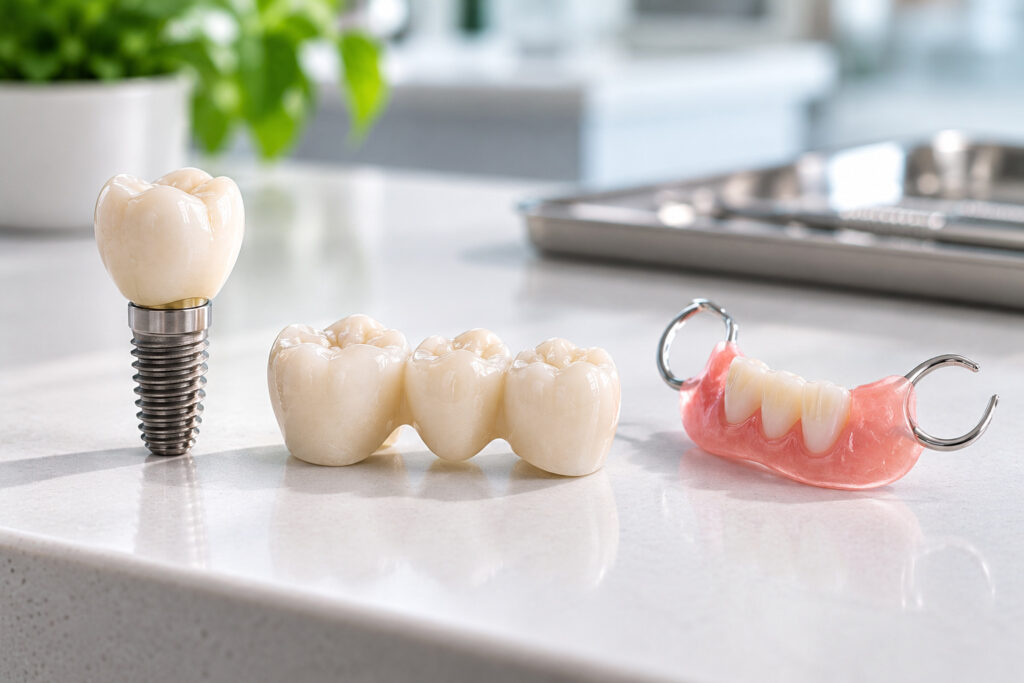
When a tooth is lost, there are three main ways to replace it: a dental implant, a bridge or a denture. Each works differently and suits different situations. This article explains how they compare, so you can have an informed conversation with your dentist about the right option for you.
Why replace a missing tooth?
A gap can affect chewing, speech and appearance. Over time, the teeth next to the gap can tip or drift into the space, and the opposing tooth can grow down into it. This can change the bite and make the area harder to clean. Not every gap needs to be filled, though, and in some cases leaving it is a reasonable choice.
Dental implants
A dental implant is a small titanium post placed in the jaw bone to replace the root of a missing tooth. Once the bone has bonded to it, a crown or bridge is attached.
- Advantages: fixed in place, and does not rely on the neighbouring teeth for support, so they do not need to be prepared. Because the implant sits in the bone, it may help maintain the bone in that area.
- Limitations: involves surgery and a healing period of several months. It needs healthy gums and enough bone, and a bone graft may be needed first. Smoking, poorly controlled diabetes and certain medicines can affect healing. Like any surgical procedure, it carries risks.
Bridges
A conventional bridge replaces one or more missing teeth by joining a false tooth to crowns on the teeth on either side of the gap. An implant-supported bridge uses implants instead of natural teeth for support.
- Advantages: fixed in place, usually completed over a few appointments, and does not involve surgery.
- Limitations: the teeth on either side need to be shaped for crowns, which removes healthy tooth structure. The bridge depends on those teeth staying healthy, and cleaning under the false tooth needs a floss threader or interdental brush.
Dentures
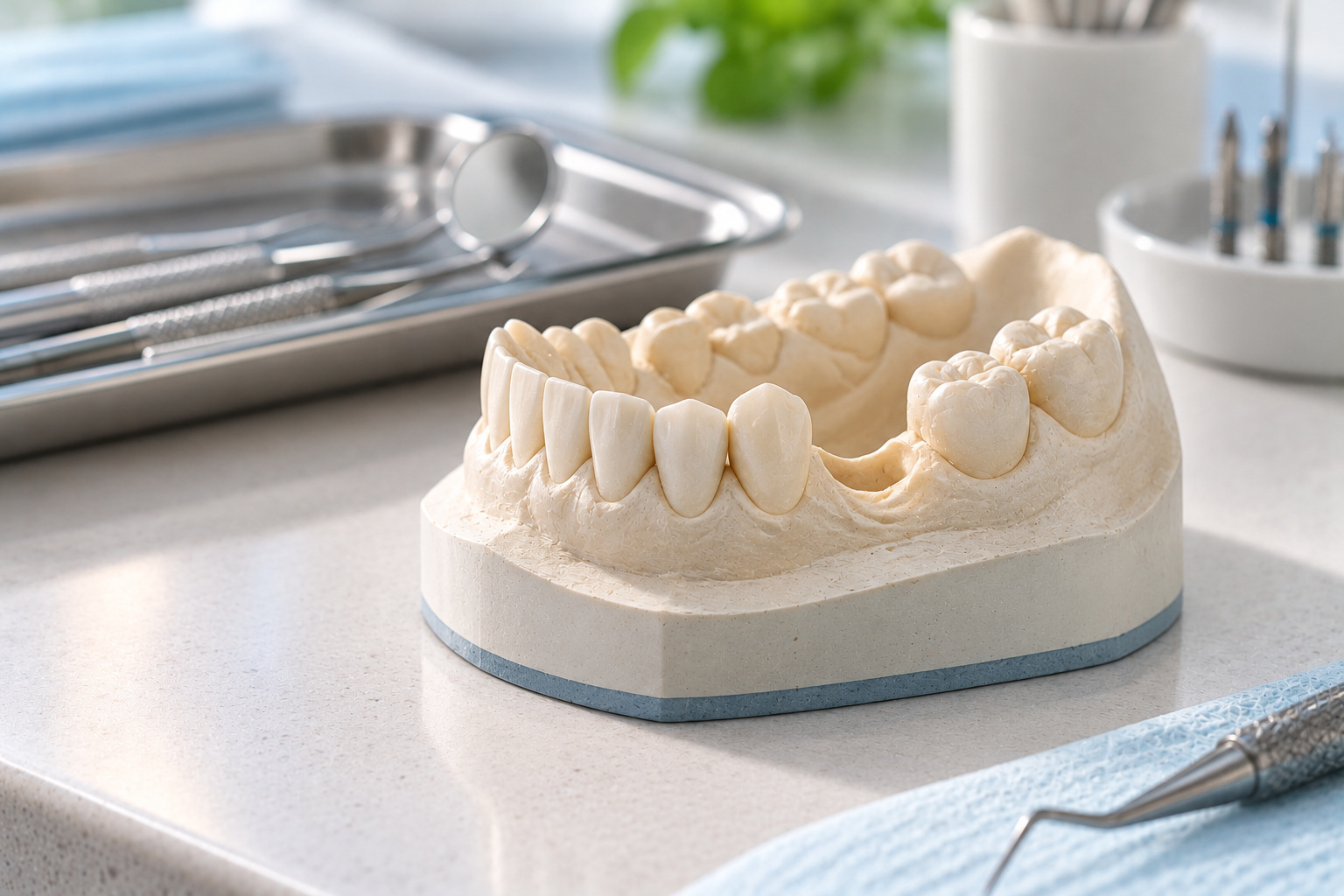
Dentures are removable replacements for missing teeth. A partial denture replaces some teeth and clips onto the remaining ones. A full denture replaces all the teeth in a jaw.
- Advantages: no surgery, can replace many teeth at once, and further teeth can often be added later if needed.
- Limitations: removable, and can feel less stable than fixed options, particularly lower full dentures. It can take time to get used to eating and speaking with them, and they may need adjusting or relining as the gums and bone change.
At a glance
| Implant | Bridge | Denture | |
|---|---|---|---|
| Fixed or removable | Fixed | Fixed | Removable |
| Surgery | Yes | No | No |
| Effect on neighbouring teeth | None | Shaped for crowns | Clasps may rest on them |
| Typical treatment time | Several months | A few weeks | A few weeks |
| Cleaning | Like natural teeth | Clean under the false tooth | Removed and cleaned daily |
How long do they last?
With good care, implants, bridges and dentures can all last many years, but none of them lasts for ever. How long a replacement lasts depends on cleaning at home, regular check-ups, grinding or clenching, smoking, general health and the health of the surrounding teeth and gums. Implants can be affected by gum inflammation around them, bridges by decay in the supporting teeth, and dentures by wear and changes in the shape of the gums and bone.
What affects the choice
The right option depends on how many teeth are missing and where, the health of the neighbouring teeth and gums, the amount of bone, general health and medicines, and personal preferences about surgery, treatment time and cost. A dentist can explain which options suit your situation, and the risks and benefits of each.
Common questions
Which option looks most natural?
All three can look natural when well made. Implant crowns and bridges are fixed, so they are often described as feeling the most like natural teeth. Modern dentures can also look natural, although they are removable.
Can I have an implant if I already wear a denture?
Often, yes, if there is enough healthy bone and the gums are healthy. An assessment with a 3D scan shows whether an implant is suitable.
Is a bridge bad for the neighbouring teeth?
Preparing teeth for crowns removes healthy tooth structure, and the supporting teeth need careful cleaning. Where the neighbouring teeth already have large fillings or crowns, this matters less.
Do I need to replace a back tooth?
Not always. Some people manage well with a gap, particularly at the very back of the mouth. A dentist can explain whether leaving the gap is likely to cause problems in your case.
More information: dental implants, crowns, bridges and dentures, and types of dentures.