General information only. This article explains dental topics in general terms and isn’t a substitute for personal advice. Everyone’s oral health and dental needs are different, so please see a dentist for advice that applies to you.
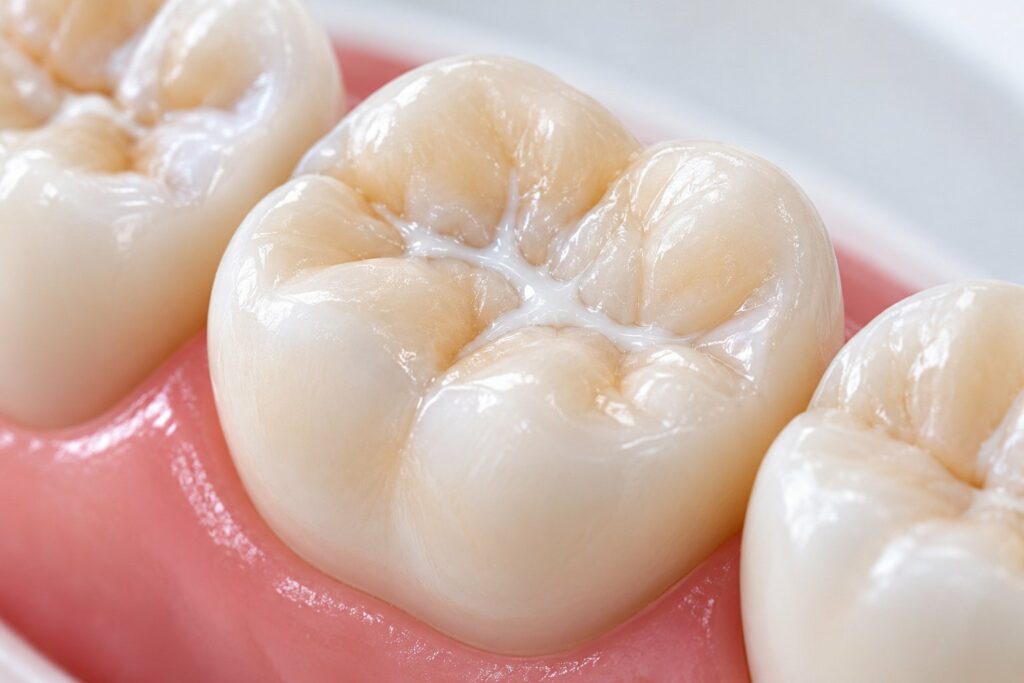
Fissure sealants are thin protective coatings painted onto the chewing surfaces of back teeth. They fill the deep grooves (fissures) where food and plaque collect and where decay often starts. This article explains how sealants work, who they may suit, what having them placed involves and how long they last.
How sealants help prevent decay
The chewing surfaces of molars have narrow pits and grooves that toothbrush bristles cannot fully clean. Sealing them creates a smooth surface that is easier to keep clean and stops plaque bacteria settling in the grooves. Research reviews have found that sealants reduce decay on the chewing surfaces of children’s permanent molars compared with no sealant. They work alongside, not instead of, brushing with fluoride toothpaste, a low-sugar diet and regular check-ups.
Who may benefit
- Children, usually soon after the permanent molars come through, at around 6 years and again at around 12 years, while the grooves are most at risk.
- Teenagers and adults with deep grooves and no decay or fillings on those surfaces, especially if they have a higher risk of decay.
- Some baby teeth with deep grooves, in children who are prone to decay.
Sealants are not suitable for surfaces that already have decay or a filling. Whether they are recommended depends on the tooth’s shape and your risk of decay, which the dentist assesses at a check-up. See children’s dentistry.
What to expect
- The teeth are cleaned and dried.
- A mild gel is applied for a short time to prepare the surface, then rinsed off.
- The tooth is kept dry while the sealant is painted into the grooves.
- A blue curing light sets the sealant within seconds.
- The bite is checked and adjusted if needed.
No injection or drilling is usually needed, and each tooth takes only a few minutes. Some sealants are resin-based; others are glass ionomer, which can be used when keeping the tooth completely dry is difficult and which releases a small amount of fluoride.
Prevention compared with repair
Once decay forms a cavity, it needs a filling, and filled teeth need ongoing maintenance. Preventing decay in the first place avoids that cycle and is usually a more comfortable experience, particularly for young children.
How long sealants last
Sealants can last several years, but they can wear or chip. They are checked at each visit and topped up or replaced when needed. Avoid chewing ice or very hard objects.
Common questions
Are sealants safe?
Yes. Sealants have been used for decades. Some resin sealants can release extremely small amounts of BPA immediately after placement; the levels are far below those considered harmful and are lower than everyday exposure from other sources.
Are sealants covered by health funds?
Many extras policies include fissure sealants as preventive treatment. Eligible children may also be covered through the Child Dental Benefits Schedule. Check with your health fund or Medicare for your situation.