General information only. This article explains dental topics in general terms and isn’t a substitute for personal advice. Everyone’s oral health and dental needs are different, so please see a dentist for advice that applies to you.
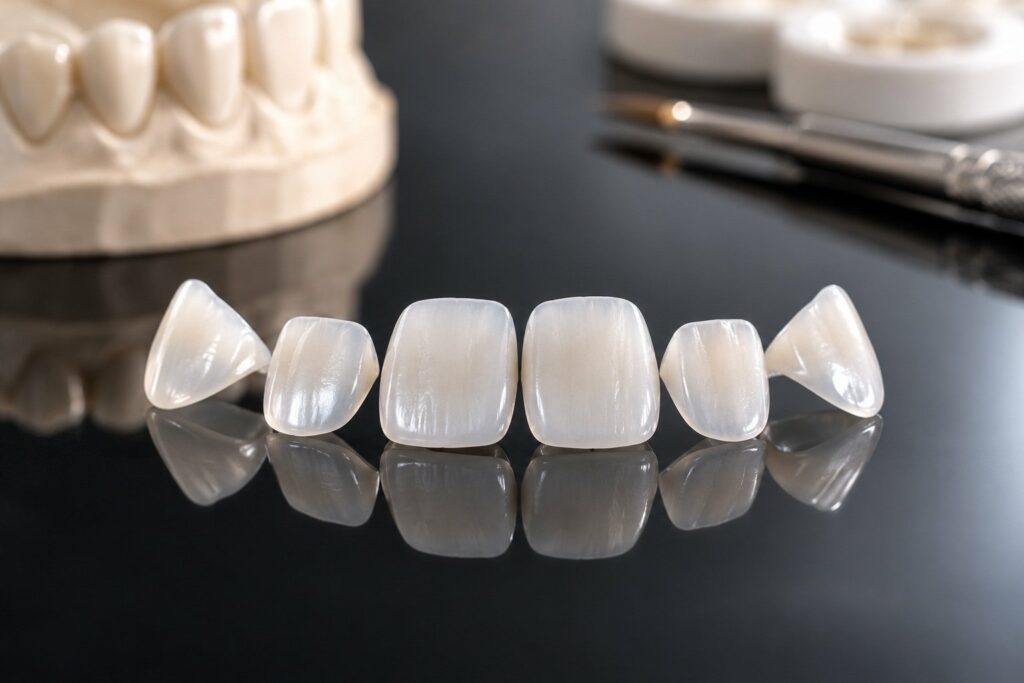
Dental veneers are thin shells of porcelain or composite resin bonded to the front of the teeth to change their colour, shape, size or length. This article explains what veneers can treat, including closing gaps, the steps involved, how long they last, whether they are permanent, caring for them, risks, and the alternatives.
What veneers can treat
- Discolouration that whitening cannot lift, such as some intrinsic stains.
- Chips, cracks and worn edges.
- Uneven or irregularly shaped teeth.
- Small gaps between teeth.
- Minor misalignment that does not need orthodontic treatment.
Porcelain and composite veneers
| Porcelain | Composite resin | |
|---|---|---|
| Made | In a dental laboratory | Usually built up directly on the tooth |
| Visits | Usually two or more | Often one |
| Stain resistance | High | Lower; can discolour over time |
| Typical lifespan | Often 10–15 years | Often 5–7 years |
| Tooth preparation | Usually a thin layer of enamel removed | Often less or none |
| Repairs | Usually replaced if broken | Can often be repaired |
Closing gaps with veneers
Gaps between teeth (diastema) can be due to tooth size, genetics or habits such as thumb-sucking. Veneers can close small gaps by making the teeth slightly wider, shaped to match the neighbouring teeth. This gives a quicker result than orthodontic treatment, but it does not move the teeth, so larger gaps or misaligned teeth may be better treated with braces or aligners first. Any gum disease needs treating before gaps are closed.
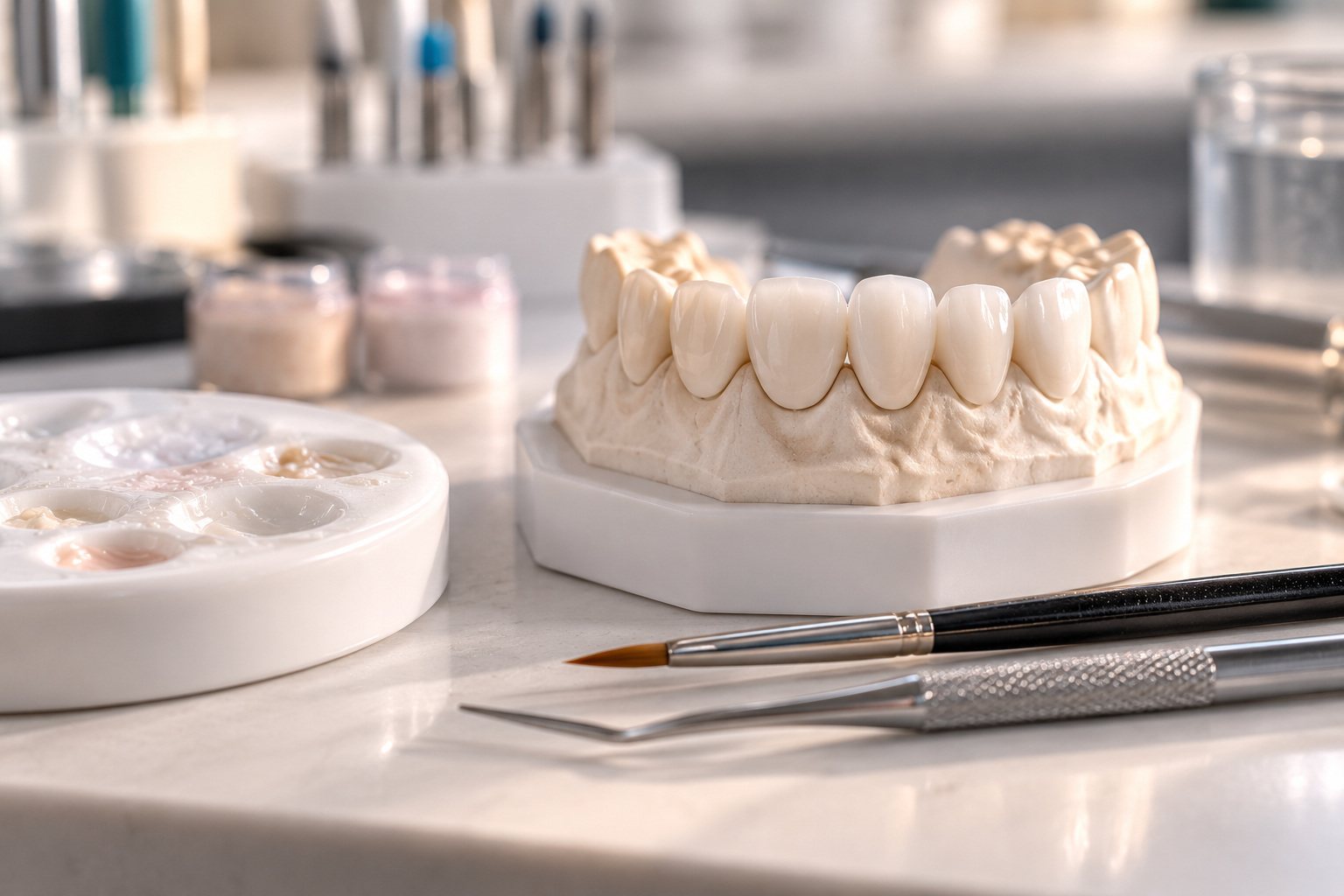
Steps in getting veneers
- Consultation and assessment. The teeth and gums are examined and X-rays taken if needed. Goals and expectations are discussed, along with the options, materials and costs.
- Treating other problems first. Decay or gum disease is treated before veneers are made.
- Preparation. For porcelain veneers, a thin layer of enamel is usually removed from the front of the teeth, often under local anaesthetic, so the veneers do not look bulky.
- Impressions or scans. These are sent to a dental laboratory, and a shade is chosen. Temporary veneers may be fitted while the final ones are made, usually over one to two weeks.
- Fitting. The fit and colour are checked, then each veneer is bonded with a dental adhesive that is hardened with a curing light. Final adjustments are made to the bite.
How long veneers last
Porcelain veneers often last 10 to 15 years and composite veneers around 5 to 7 years, although this varies. Lifespan depends on:
- Material: porcelain resists staining and wear better than composite.
- Oral hygiene: decay around the edges of a veneer can shorten its life.
- Grinding or clenching: this can chip or crack veneers; a night guard is often advised.
- Habits and diet: biting ice, pens or fingernails, or using teeth to open packets, can damage veneers. Smoking and staining drinks can discolour composite.
- Regular check-ups: problems can be found and fixed early.
Are veneers permanent?
Veneers are not permanent in the sense that they will eventually need replacing. However, porcelain veneers usually involve removing some enamel, which cannot be restored. This means a tooth that has had a porcelain veneer will always need a covering of some kind, whether a new veneer, a crown or bonding. Veneers can be removed by a dentist with specialised tools, but the tooth will not return to its original state.
Caring for veneers
- Brush twice a day with a soft toothbrush and non-abrasive fluoride toothpaste, and floss daily around the edges.
- Keep up regular check-ups and professional cleans.
- Avoid biting hard objects and using teeth as tools.
- Wear a night guard if you grind your teeth, and a mouthguard for contact sports.
- Limit coffee, tea, red wine and other staining foods, or rinse with water afterwards, particularly with composite veneers.
- Some dentists suggest an alcohol-free mouthwash for people with bonded restorations.
Possible risks
- Sensitivity to hot and cold after preparation, which is usually temporary.
- Chipping, cracking or debonding, particularly with grinding.
- A poor fit or colour match, which may need adjustment or remaking.
- Removal of enamel is irreversible.
- Rarely, a reaction to materials used.
Who veneers suit
Veneers suit people with healthy teeth and gums and realistic expectations. They are not suitable for every problem: severe misalignment may need orthodontic treatment first, and people who grind their teeth or have had dental trauma may need protective measures or a different option.
Alternatives
- Teeth whitening for surface staining, without changing tooth structure.
- Composite bonding to repair chips or close small gaps, usually with little or no enamel removal, though it is less durable and stain-resistant than porcelain.
- Orthodontic treatment such as braces or aligners, which moves the teeth rather than covering them.
- Crowns for teeth that are heavily damaged or filled.
Choosing a dentist
Check that the dentist is registered on the AHPRA public register, ask about their experience with veneers and the materials they use, and make sure the options, risks and expected lifespan have been explained. It is reasonable to ask for time to think, or a second opinion, before having enamel removed.