General information only. This article explains dental topics in general terms and isn’t a substitute for personal advice. Everyone’s oral health and dental needs are different, so please see a dentist for advice that applies to you.
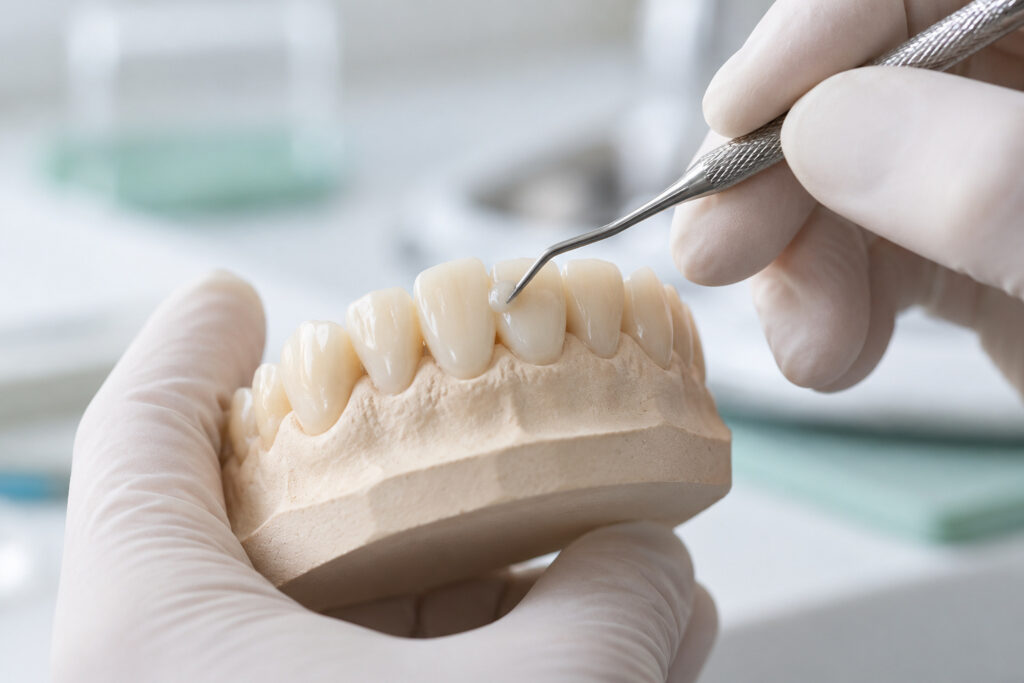
Composite bonding is a way of repairing or reshaping a tooth by adding tooth-coloured resin directly to its surface. The material is shaped by hand in the mouth and hardened with a special light, usually in a single appointment. It is one of the most commonly used materials in general dentistry.
What composite resin is
Composite resin is a mixture of plastic resin and fine glass or ceramic particles. It comes in a range of shades so it can be matched to the colour of the surrounding teeth, and it bonds to the tooth surface with an adhesive. The same material is used for tooth-coloured fillings.
What bonding is used for
- Repairing chipped or broken edges of teeth.
- Covering exposed or worn root surfaces near the gum line.
- Building up teeth worn by grinding or erosion.
- Closing small gaps between teeth.
- Changing the shape of small or uneven teeth.
- Covering some types of discolouration.

How bonding is done
The shade of resin is chosen to match the tooth. The tooth surface is cleaned and treated so the adhesive can bond to it. The resin is then applied in layers, each one shaped and hardened with a curing light. Finally, the bonding is trimmed, shaped and polished to blend in with the tooth.
Because the resin is added to the tooth, little or no tooth structure usually needs to be removed. Local anaesthetic is often not needed, although it may be used when bonding is placed near the gum or over a sensitive area.
Limitations
Composite resin is not as hard or stain-resistant as porcelain. Over time it can chip, wear, pick up stains from tea, coffee, red wine and smoking, and lose some of its polish. Bonding can usually be repaired, polished or replaced when this happens. How long bonding lasts varies with its size and position, biting forces, grinding and diet.
Bonding may not be suitable for teeth that are heavily broken down, for large changes in tooth shape, or where biting forces are very high. In these situations, a crown or other restoration may be more appropriate.
Bonding compared with other options
Crowns and porcelain restorations are made in a dental laboratory and generally require more of the tooth to be shaped. They are stronger and more stain-resistant, but involve more appointments and removal of tooth structure. Bonding is more conservative of the natural tooth but generally needs more maintenance over time. The right option depends on the tooth and what it needs.
Common questions
Does bonding damage the tooth?
Bonding usually involves little or no removal of tooth structure, as the resin is added to the surface. The tooth surface is roughened slightly so the adhesive can bond to it.
Can bonding be whitened?
No. Whitening does not change the colour of composite resin. If teeth are to be whitened, this is usually done before bonding so the resin can be matched to the new shade.
Is bonding the same as a filling?
They use the same material. A filling replaces tooth structure lost to decay, while bonding is often added to the outside of a tooth to repair a chip or change its shape.
Is bonding covered by health funds?
Many health fund extras policies contribute to bonding and tooth-coloured fillings, depending on the policy and the reason for treatment.
When to see a dentist
See a dentist if a tooth has chipped, has a sharp edge, or has become sensitive near the gum line. More information: restorative dentistry.