General information only. This article explains dental topics in general terms and isn’t a substitute for personal advice. Everyone’s oral health and dental needs are different, so please see a dentist for advice that applies to you.
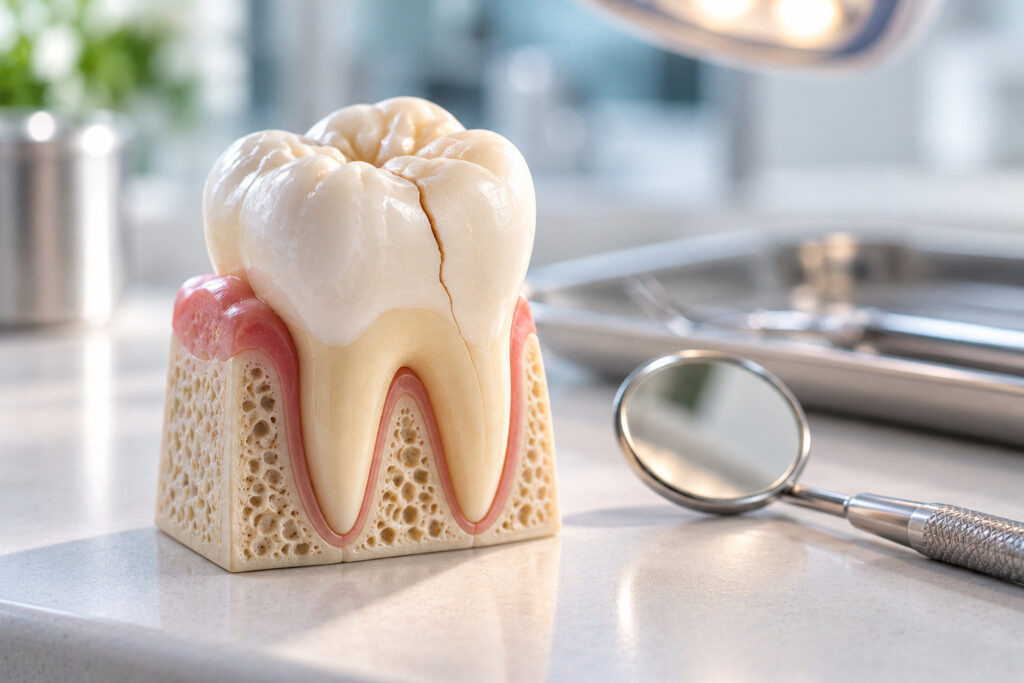
A cracked tooth can be hard to pin down. The pain often comes and goes, may only happen when biting a certain way, and can be difficult to locate. Cracks are common in adults, particularly in back teeth, and finding them early can make treatment simpler.
Signs of a cracked tooth
- A sharp pain when biting, especially when releasing the bite.
- Sensitivity to cold, or sometimes to sweet foods.
- Pain that comes and goes rather than being constant.
- Difficulty telling exactly which tooth hurts.
- In some cases, swelling of the gum around the tooth.
Some cracks cause no symptoms at all and are found during a check-up.
Types of cracks
- Craze lines are tiny, shallow lines in the enamel. They are very common, usually harmless and generally need no treatment.
- Fractured cusp. Part of the chewing surface breaks off, often around a large filling. It is usually not very painful because it rarely reaches the nerve.
- Cracked tooth. A crack runs from the chewing surface down towards the root. Over time it can spread and reach the nerve.
- Split tooth. A crack that has divided the tooth into separate parts. It usually develops from an untreated cracked tooth.
- Vertical root fracture. A crack that starts in the root. It may cause few symptoms until the surrounding bone and gum become infected.
Common causes
Cracks often result from biting on something hard, such as ice, hard lollies, popcorn kernels, nut shells or bones. Grinding and clenching, large fillings that weaken the remaining tooth, teeth that have had root canal treatment, and injuries to the mouth all increase the risk.
How a crack is diagnosed
Cracks are often too fine to see on an X-ray. A dentist may examine the tooth under magnification and bright light, ask you to bite on a special instrument one cusp at a time to reproduce the pain, check how the tooth responds to cold, and look for changes in the gum and bone. A 3D Cone Beam CT scan is sometimes used when a root fracture is suspected.

How cracked teeth are treated
Treatment depends on where the crack is and how far it extends:
- A small crack or fractured cusp may be repaired with a filling or bonding.
- A crown is often recommended for a cracked tooth. It holds the tooth together and protects it from further cracking.
- If the crack has reached the nerve, root canal treatment may be needed before the crown.
- If the crack extends well below the gum line or the tooth has split, the tooth may need to be removed. Options for replacing it can then be discussed.
Cracks do not heal on their own and can spread over time, so it is best to have a suspected crack checked early.
Common questions
Can a cracked tooth heal by itself?
No. Unlike bone, enamel and dentine cannot repair a crack. Treatment aims to stop the crack spreading and to protect the tooth.
Why didn’t the crack show on my X-ray?
Most cracks run in a direction that a standard X-ray cannot capture, and they are often finer than the X-ray can show. Diagnosis usually relies on symptoms, a bite test and examination under magnification.
Will a crown definitely save a cracked tooth?
A crown gives a cracked tooth the best chance by holding it together, but it cannot guarantee the result. If the crack has already spread deeply, the tooth may later need root canal treatment or removal. This is why early assessment matters.
Is a cracked tooth an emergency?
A crack without swelling is usually not an emergency, but it should be checked soon. Swelling, severe pain or a tooth that has split needs prompt attention.
When to see a dentist
See a dentist if you have pain on biting, pain that comes and goes, or a piece of tooth breaks off. If you have swelling or severe pain, seek care as soon as possible. Facial swelling with a fever, or difficulty swallowing or breathing, needs urgent medical care.